Odoo continues to evolve from a traditional ERP system into a comprehensive digital platform that does more than store business data. It helps teams work faster, sell more effectively, and make decisions with less manual effort.
Released in July 2026, Odoo 19.4 introduces significant improvements across AI, CRM, Sales, eCommerce, Website, Appointments, and other business applications. The direction of the release is clear: fewer repetitive actions, stronger connections between workflows, and a shorter path from information to action.
Let us explore the updates that could deliver the greatest practical value for businesses.
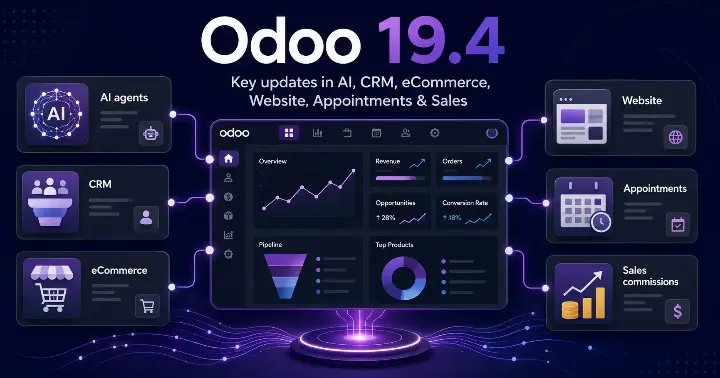
AI agents can now connect with external tools
One of the headline features of Odoo 19.4 is the expansion of AI agents, which can now connect with external tools.
This represents an important step in Odoo’s AI strategy. Previously, AI capabilities were primarily focused on working with information inside the platform: analysing data, generating content, processing documents, and assisting users with specific tasks.
Odoo is now moving towards a model in which an AI agent can participate in an end-to-end business process and interact not only with internal ERP records but also with third-party services.
In practice, this creates opportunities for AI agents to:
- retrieve information from external sources;
- initiate related actions across different systems;
- help synchronise information between Odoo and other business tools;
- reduce manual switching between applications;
- support more sophisticated automated workflows.
For businesses, this means that AI inside an ERP system is gradually becoming more than a content-generation assistant. It is developing into an operational automation tool.
The effectiveness of these agents will still depend on correctly configured access rights, reliable data, and clearly defined processes. However, the potential is much broader: AI can increasingly move from preparing information to helping execute actual business operations.
CRM becomes more effective for existing customers
Many companies have a well-structured CRM process for acquiring new leads but a much weaker process for renewals and additional sales to existing customers.
Odoo 19.4 addresses part of this challenge.
Sales representatives can access a customer’s existing subscriptions directly from a lead and create upsell or renewal quotations without moving between multiple applications and records.
This is especially valuable for companies offering:
- recurring services;
- support contracts;
- subscriptions;
- software licences;
- periodic maintenance;
- prepaid service packages;
- SLA-based support.
For example, when an existing customer submits a new request, the sales representative can immediately see the active subscription and the relevant commercial context from the CRM record. They can then prepare a renewal or expanded service proposal from the same workflow.
Fewer screen changes mean fewer missed opportunities.
Although this may appear to be a relatively small interface improvement, it can directly influence customer lifetime value, sales efficiency, and the speed of repeat transactions.
Better alignment between commissions and collected revenue
Odoo 19.4 continues to improve sales commission management.
The updated commission logic can support models based on payments actually received rather than only confirmed orders or issued invoices.
This allows companies to align sales incentives more closely with real cash flow.
It can help prevent situations where:
- a commission is paid before the customer has paid the invoice;
- strong reported sales do not translate into actual cash collection;
- finance teams have to verify every payment manually;
- commission calculations are maintained in separate spreadsheets.
As a result, variable compensation can be connected more directly to the company’s financial performance.
A smarter approach to website creation
Website Builder remains one of Odoo’s most actively developed areas.
In version 19.4, Odoo introduces a smarter approach to website creation. The objective is to shorten the journey from an initial idea to a complete page and make website management more accessible to marketing and business teams.
This matters because an Odoo website is not an isolated content management system. It can be directly connected with:
- CRM;
- eCommerce;
- Inventory;
- Sales;
- Payments;
- Marketing Automation;
- Events;
- eLearning;
- Appointments;
- the customer portal.
A new landing page can immediately capture leads in CRM, initiate a quotation process, check product availability, or trigger automated communication.
Businesses do not necessarily need a separate website platform, a separate CRM, and a large number of integrations between them. These processes can operate within one business ecosystem.
Better social media previews for Odoo websites
Odoo 19.4 improves how website links are displayed when shared on social platforms.
Sharing an Odoo website page can now generate a preview card containing the page title, description, and image.
From a marketing perspective, this is more important than it may initially appear.
A correctly generated preview can:
- attract more attention in the feed;
- explain the destination before the user clicks;
- increase trust in the link;
- improve click-through rates;
- maintain consistent brand presentation.
This is particularly relevant for blog posts, product pages, case studies, events, and landing pages promoted through LinkedIn, Facebook, and other channels.
Appointment pages become more flexible and conversion-focused
The Appointments application also receives a design update.
Online booking pages now offer a cleaner and easier-to-use experience. Website Editor blocks can also be added throughout Appointment pages.
This gives businesses greater control over the information customers see before booking.
A booking page can include:
- a detailed service description;
- information about the consultant or specialist;
- company benefits;
- customer testimonials;
- frequently asked questions;
- cancellation or rescheduling terms;
- additional calls to action.
The appointment page can therefore become more than a calendar. It can function as a complete conversion page.
This is useful for consulting firms, clinics, service centres, educational providers, agencies, and B2B companies offering demos or discovery calls.
eCommerce: fewer obstacles between interest and purchase
Odoo 19.4 also brings new Sales and eCommerce capabilities.
The broader direction is to simplify the buying journey while maintaining full integration with the company’s operational processes.
When eCommerce operates inside Odoo, a confirmed online order can automatically trigger:
- stock availability checks;
- product reservation;
- delivery operations;
- invoice creation;
- payment registration;
- marketing workflows;
- customer history updates in CRM.
This level of integration remains one of Odoo’s strongest advantages over a collection of disconnected business applications.
Storefront improvements are not only about visual design. Every unnecessary step, unclear field, or inconvenient mobile screen can affect conversion rates. Even relatively small UX improvements can therefore produce measurable commercial results.
What Odoo 19.4 means for businesses
This release should not be viewed simply as another collection of new buttons.
Odoo 19.4 demonstrates three strategic directions in the platform’s development.
1. AI becomes part of operational workflows
Artificial intelligence is gradually moving beyond content generation towards interacting with data, business systems, and external tools.
2. Sales workflows become more contextual
Sales representatives receive more relevant information directly in CRM, including active subscriptions and opportunities for renewals and additional sales.
3. Websites and eCommerce become more deeply integrated with ERP
Odoo continues to connect the external customer experience with internal processes such as sales, inventory, finance, marketing, and customer service.
Should every company upgrade to Odoo 19.4 immediately?
A new release number alone is not a sufficient reason to begin a migration.
The decision should be based on an assessment of:
- the current Odoo version;
- the applications being used;
- the volume of custom code;
- third-party integrations;
- business-critical workflows;
- testing and migration costs;
- the practical value of the new features for the team.
For new implementations, Odoo 19.4 may be a logical current foundation.
For existing systems, it is usually better to begin with a functional and technical audit, verify the compatibility of custom modules, and prepare a controlled upgrade plan.
Conclusion
Odoo 19.4 continues the platform’s broader transformation: an ERP system should no longer be a place where employees simply record work after it has been completed.
It should actively help them perform that work.
AI agents connected to external tools, more convenient renewal and upsell processes, flexible appointment pages, smarter website creation, and new eCommerce capabilities all bring Odoo closer to that objective.
However, the real value of a release does not appear when someone clicks the Upgrade button. It appears when the new functionality is correctly embedded into the company’s actual workflows.
Netframe helps businesses implement, customise, integrate, and upgrade Odoo according to their operational requirements.
Are you planning a new Odoo implementation or evaluating whether your current system should be upgraded to version 19.4?
Contact our team. We will assess your workflows, custom modules, and integrations and recommend an approach focused on measurable business results—not simply a newer version number.